
INTRODUCTION
In today’s competitive digital environment, simply having a website isn’t enough to draw in customers. With millions of websites vying for attention on search engines like Google, it’s hard for businesses to make themselves noticeable. That’s where Search Engine Optimization, or SEO, plays a crucial role. SEO is the practice of making your website appear higher in search engine results, helping potential customers find your business more easily.
A website that’s properly optimized not only increases its visibility but also brings in high-quality organic traffic, enhances user experience, strengthens brand trust, and leads to more leads and sales.
Unlike paid advertisements, SEO offers lasting advantages by helping your website maintain strong rankings over time. Whether you run a small business, an online store, or a personal blog, using effective SEO techniques can greatly boost your online presence.
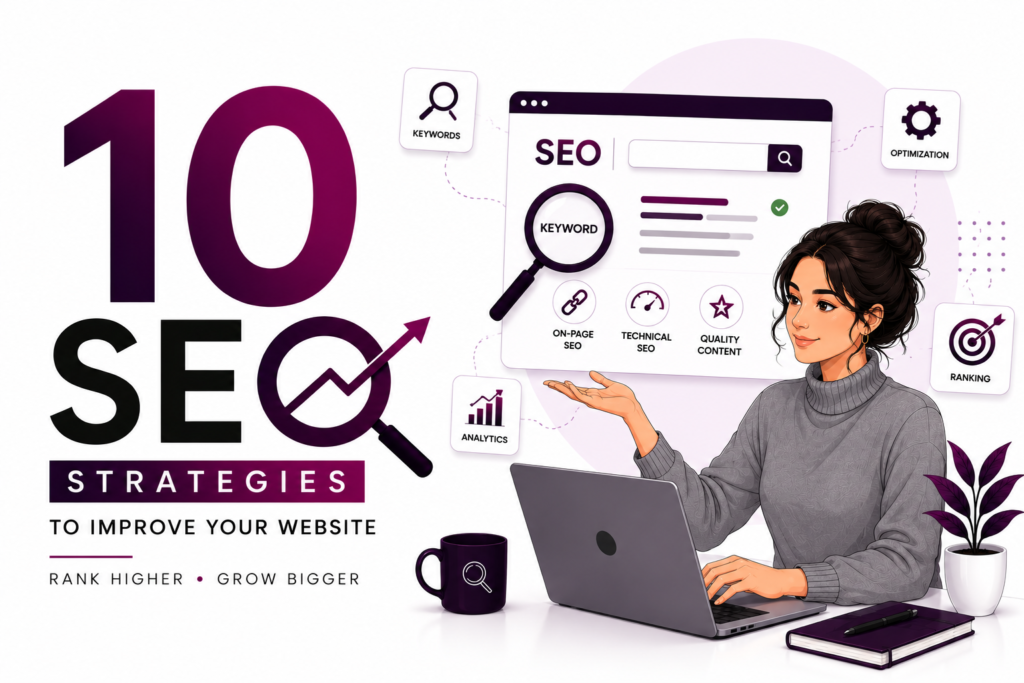
In this blog, we will discuss 10 SEO strategies to boost your website ranking and support your ongoing growth.
1. Conduct In-depth Keyword Research
Keyword research is the starting point of any successful SEO plan.
It helps you understand what your audience is looking for and enables you to develop content that addresses their needs.
Begin by finding keywords relevant to your business, products, or services.
Focus on a mix of short-tail keywords, like “SEO tips,” and long-tail keywords, such as “SEO strategies to improve website ranking,” to reach both general and specific audiences.
Select keywords that have a high search volume and manageable competition, and naturally include them in your titles, headings, URLs, meta descriptions, and throughout your content.
Steer clear of overstuffing keywords, as search engines favor content that feels natural and is helpful to users.
2. Create High-Quality and Valuable Content
Content remains one of Google’s most important ranking factors. Search engines aim to provide users with the most relevant, informative, and trustworthy content available.
When writing blog posts or website pages, focus on solving your audience’s problems rather than simply promoting your products or services. Use clear language, organize information with headings and subheadings, and include practical examples whenever possible.
Regularly updating existing content also helps maintain rankings by ensuring your information stays accurate and relevant. Fresh, valuable content encourages visitors to spend more time on your website, which can positively influence SEO performance.
3. Optimize On-Page SEO Elements
On-page SEO refers to optimizing the individual elements of your website that help search engines understand your content.
Every page should include:
* A unique and keyword-rich title tag
* An engaging meta description
* Proper heading tags (H1, H2, and H3)
* SEO-friendly URLs
* Relevant internal links
* Image alt text
* Natural keyword placement
These elements improve both search engine visibility and user experience, making it easier for visitors to find the information they need.
4. Improve Website Loading Speed
Improving your website’s loading speed is essential for both user satisfaction and search engine performance. Users expect websites to load quickly, and even a small delay can lead to higher bounce rates and lower engagement.
To enhance your website’s speed:
– Compress images before uploading them to reduce file sizes.
– Enable browser caching to store frequently accessed data.
– Minify CSS, JavaScript, and HTML files to remove unnecessary characters.
– Select a dependable web hosting provider for faster performance.
– Remove any unused plugins that may slow down your site.
– Implement lazy loading for images so they load only when needed.
A faster website helps keep visitors on your site longer and sends favorable signals to search engines.
5. Make Your Website Mobile-Friendly
Most internet users access websites through their smartphones, making mobile optimization a crucial factor.
Google primarily uses the mobile version of a site when determining search rankings.
Ensure your website:
– Has a responsive design that adapts to different screen sizes.
– Displays properly on all devices without distortion.
– Features text that is easy to read without requiring zooming.
– Includes buttons that are simple to tap on smaller screens.
– Loads quickly on mobile devices to provide a smooth browsing experience.
A mobile-friendly website enhances user experience and boosts your chances of achieving better search engine rankings.
6. Build High-Quality Backlinks
Backlinks are links from other websites pointing to your website. They act as votes of confidence and help search engines determine the authority and credibility of your content.
Focus on earning backlinks from reputable and relevant websites by:
* Publishing valuable blog content.
* Writing guest posts.
* Creating shareable infographics.
* Building relationships with industry experts.
* Listing your business in trusted directories.
Quality matters far more than quantity. A few authoritative backlinks can be much more valuable than hundreds of low-quality links.
7. Optimize Images for SEO
Images can improve the user experience, but they should also be optimized to support search engine visibility.
Before uploading the images follow these steps:
* Decrease file sizes to ensure quicker loading times.
* Use clear and descriptive file names that accurately represent the image content.
* Add relevant alt text to describe the image , which helps screen readers and search engines understand the context.
Optimizing images helps improve website speed and allows search engines to better understand the visual content on your site. This can also increase the likelihood of your images appearing in Google Image Search results.